
- November 23, 2026
- Business
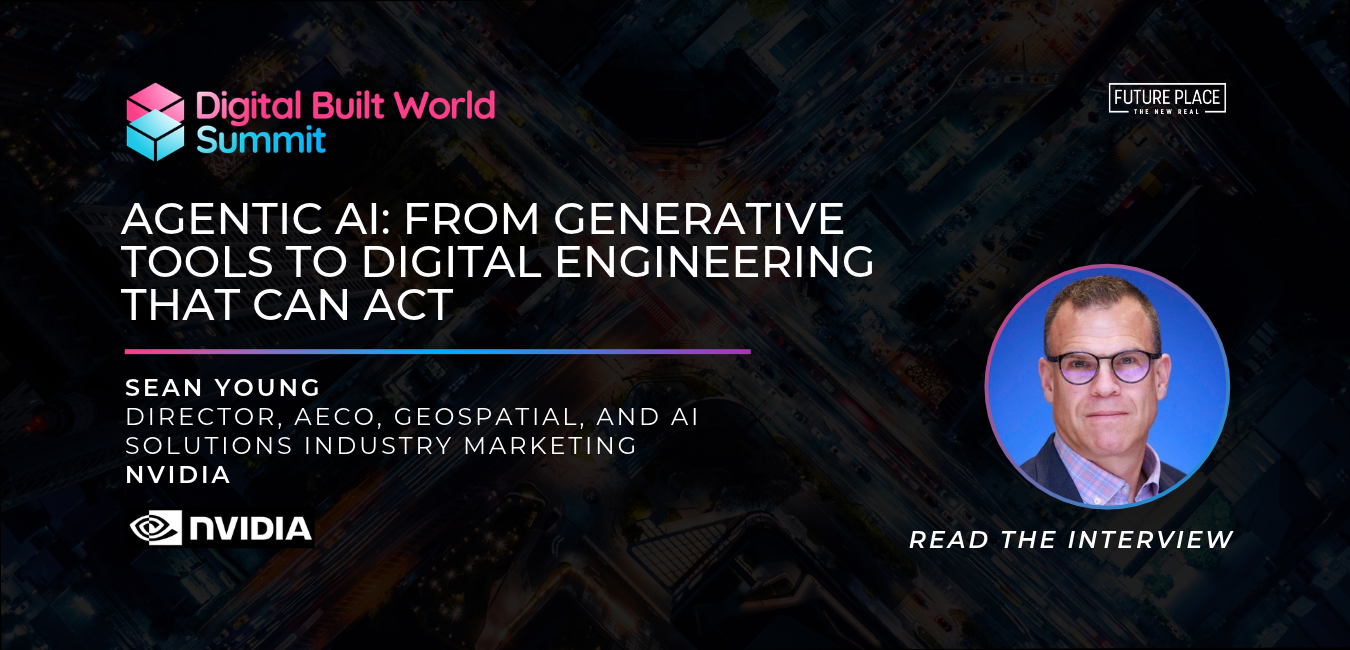
Sean Young leads industry marketing for AECO, geospatial and AI solutions at NVIDIA. His work focuses on how accelerated computing, AI, digital twins and spatial technologies can be applied to real-world industry challenges. He has presented internationally on the convergence of AI, geospatial technology and digital twins, including the emerging role of AI agents in spatial environments.
Sean will be speaking at the Digital Built World Summit in Sydney, bringing a global technology perspective to the rapid evolution of AI across architecture, engineering, construction and infrastructure. In advance of the event, he shared some trends on Agentic AI
1. Agentic AI is being described as the next major step beyond generative AI. What is driving its adoption in AECO — and where do you see the greatest value emerging?
Sean – AI has our collective knowledge along with the power to reason and predict, generative AI has the power to create, and agentic AI has the power to automate.
Most of your readers have “chatted” with AI, but how many have asked it to build an entire project from beginning to end – autonomously? That’s Agentic AI – and it’s here now.
2. As AI agents become more capable, how do we make sure they produce reliable outcomes?
Sean –There’s a lot to unpack in that question, and it’s best for your readers to attend Digital Built World in March where I will get into all the details.
In a nutshell – the key is to limit the reasoning the AI model needs to do – especially non-customized frontier models – by providing it guidance and guardrails in the form of skills, rules, and knowledge graphs.
Fine-tuned local models (trained on your data) can also help a lot.
The other critical element iis the use of MCP Servers that enable AI Agents to control traditional software applications via their API.
Agents working with industry standard software, templates, and schemas – along with fine tuned models, agentic skills, rules, and knowledge graphs – can produce reliable and repeatable outcomes.
3. What is the real business value of AI agents for AEC organisations?
Sean – Agentic AI gets work done while humans do other things, include sleep.
A human can deploy a virtual team of agents to solve multiple problems simultaneously, including exploration of multiple design alternatives and looping of geometry to simulation.
The firms that discover the secret to harnessing this superpower are going to be leaps ahead of competitors in terms of productivity and innovation.
Sean Young will explore these trends and the changing role of AI in the built environment at the Digital Built World Summit.











 Hexagon is the global leader in digital reality solutions, combining sensor, software and autonomous technologies. Our solutions free our customers to harness the rapidly-increasing amounts of data, putting it to work to boost efficiency, productivity, quality and safety across industrial, manufacturing, infrastructure, public sector and mobility applications.
 Willow is the “digital twin” for the built world. Through its software, Willow creates a digital replica of a built asset, that collects and aggregates data into a “twin”. Through this approach, Willow


 Established in 1998, Glodon Company Limited was listed on the A-share market in May 2010 (abbreviated as Glodon, Stock Code: 002410) in China, being the first listed company in the field of construction engineering information in China. Glodon provides more than 100 “Terminal + Cloud + Big Data” based products/services, industry big data, industry new finance, and other value-added services as the provider of a digital building platform, which centres on the entire life cycle of construction projects with the professional applications of construction engineering as the core support. With more than 8,000 employees, currently, Glodon has established more than 80 branches around the world, providing services to customers in over 100 countries and regions. Its sales and service network covers more than 200 cities worldwide, providing professional applications and services to over 310,000 professional clients globally.