
- November 23, 2026
- Business
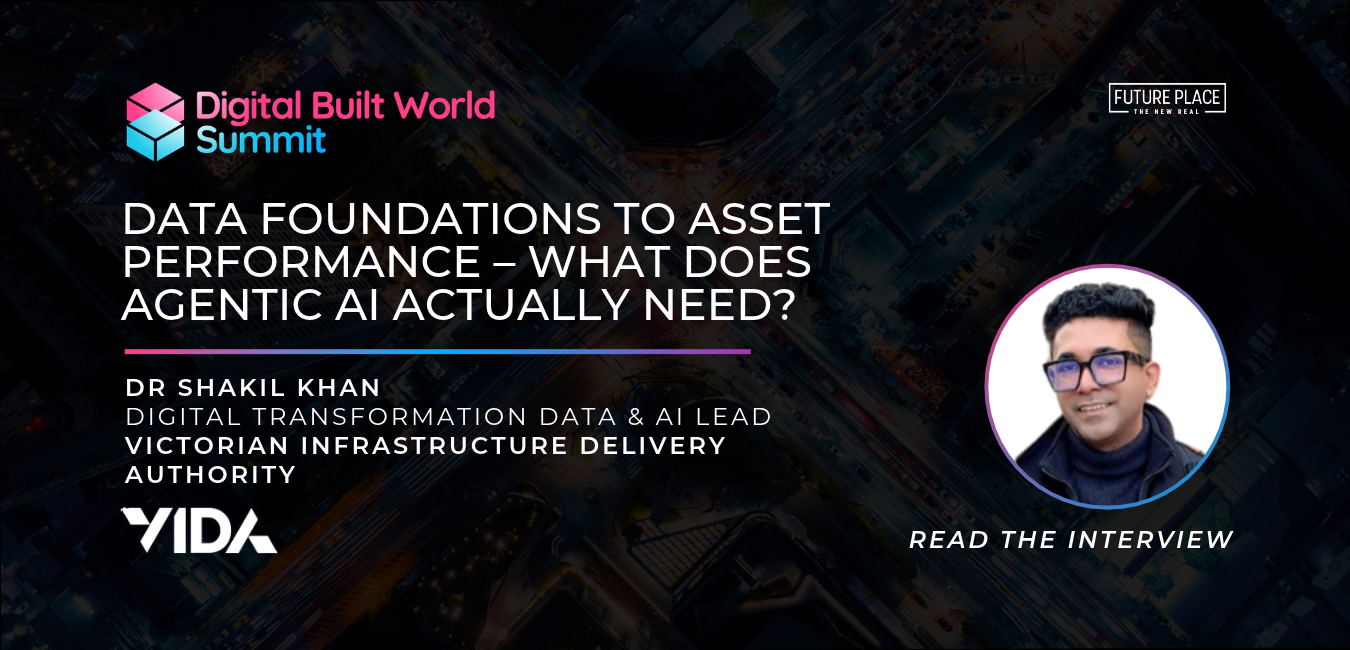
As infrastructure organisations move from AI experimentation towards practical operational applications, the quality, accessibility and structure of underlying data becomes critical. Dr Shakil Khan, Digital Transformation Data & AI Lead at VIDA, brings a digital engineering and data perspective to the question of what agentic AI actually needs to deliver meaningful asset value.
With experience spanning digital transformation, data and AI, Shakil works at the intersection of engineering, technology and operational outcomes. His work includes exploring how AI can be applied to engineering models and workflows, including a custom model in which an AI agent takes on the persona of a digital engineer to test and interrogate the model. His perspective is pragmatic: AI is another form of automation and a powerful new tool, but its usefulness is ultimately constrained by the accuracy and quality of the model and data behind it. We asked him three questions to draw out his thinking.
Q1. You’ve described AI as essentially another form of automation — a new tool. What does that perspective change about how engineering organisations should approach agentic AI?
Dr Shakil Khan – Seeing AI as automation takes away some of the mystique, and I think that’s healthy. Engineering organisations have been automating for decades: scripts, parametric design, rules-based checking, workflow tools. We already know how to evaluate automation. We ask what problem it solves, what inputs it depends on, what happens when it fails, and who is accountable for the output. Agentic AI should face the same questions.
What changes is the degree of autonomy. An agent can plan, sequence tasks and act across systems, so the consequences of poor inputs spread faster and further. That means the starting point shouldn’t be Where can we use AI? but Which workflows are well understood, well documented and supported by reliable data? Those are the places where an agent can add value quickly and safely.
It also means being realistic. AI won’t fix a broken process or an inconsistent dataset. It will run whatever you give it, faster. Organisations that treat it as a tool within a well-governed engineering process will get far more from it than those treating it as a shortcut around one.
Q2. You have experimented with an agent taking on the persona of a digital engineer to test an engineering model. What did this reveal about what an AI agent actually needs from the underlying data and model to be useful?
Dr Shakil Khan – The experiment was revealing because the agent behaved much like a new engineer joining a project. It asked sensible questions of the model, but its answers were only as good as what the model could tell it. Where the model was well structured, with consistent naming, clear relationships between elements and properly populated attributes, the agent could interrogate it meaningfully. It could find inconsistencies, trace dependencies and flag gaps.
Where the model was weaker, the agent struggled in exactly the places a human would. Missing metadata, ambiguous classifications and undocumented assumptions all reduced its usefulness. The difference is that a human engineer usually recognises when something doesn’t look right and goes to ask someone. An agent may simply carry on with confidence.
So the key lesson was that an agent needs three things. First, structured and consistent data it can reliably read. Second, context: the standards, conventions and engineering intent behind the model, not just the geometry or the values. Third, clear boundaries on what it is being asked to do. Giving the agent a defined persona and role helped a great deal, because it framed the questions it should ask and the checks it should perform.
Q3. If the model or data is not sufficiently accurate, an agent can simply automate the wrong answer. How should organisations establish the level of data quality, validation and human oversight needed before allowing AI to influence operational asset decisions?
Dr Shakil Khan – The level of assurance should match the consequence of the decision. An agent summarising maintenance records needs a very different threshold from one recommending intervention on a critical asset. I’d encourage organisations to classify use cases by risk first, then define the data quality and oversight each level requires.
For data, that means being explicit about what “good enough” looks like: completeness, accuracy, currency and provenance for the specific attributes the agent relies on. It shouldn’t be a general aspiration. It should be something you can measure and check before the agent is allowed to act.
For validation, test the agent against scenarios where the correct answer is already known, including edge cases and deliberately flawed data, so you can see how it behaves when inputs are wrong. Agents should also be designed to show their reasoning and to flag uncertainty, rather than presenting every output with the same confidence.
Human oversight remains essential, particularly early on. For consequential asset decisions, the agent should support the engineer, not replace their judgement. As performance is demonstrated over time, autonomy can be expanded step by step. Trust in AI should be earned the same way trust in any engineering tool is earned: through evidence, transparency and accountability.
If you would like to meet Shakil and others in his space, check out The Digital Built World Summit on 2-3 March in Sydney.














 Hexagon is the global leader in digital reality solutions, combining sensor, software and autonomous technologies. Our solutions free our customers to harness the rapidly-increasing amounts of data, putting it to work to boost efficiency, productivity, quality and safety across industrial, manufacturing, infrastructure, public sector and mobility applications.
 Willow is the “digital twin” for the built world. Through its software, Willow creates a digital replica of a built asset, that collects and aggregates data into a “twin”. Through this approach, Willow


 Established in 1998, Glodon Company Limited was listed on the A-share market in May 2010 (abbreviated as Glodon, Stock Code: 002410) in China, being the first listed company in the field of construction engineering information in China. Glodon provides more than 100 “Terminal + Cloud + Big Data” based products/services, industry big data, industry new finance, and other value-added services as the provider of a digital building platform, which centres on the entire life cycle of construction projects with the professional applications of construction engineering as the core support. With more than 8,000 employees, currently, Glodon has established more than 80 branches around the world, providing services to customers in over 100 countries and regions. Its sales and service network covers more than 200 cities worldwide, providing professional applications and services to over 310,000 professional clients globally.