
- November 23, 2026
- Business
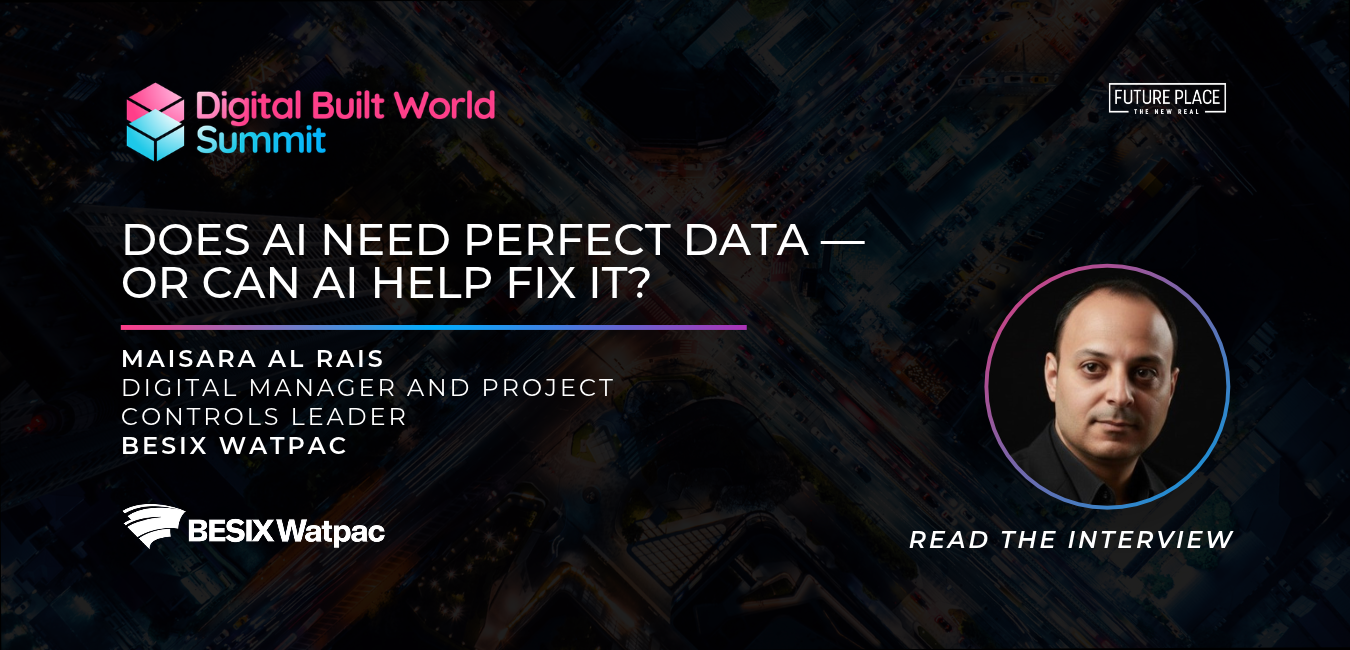
Maisara Al Rais brings more than two decades of experience across construction, project controls, digital engineering and data. His career has included senior digital engineering and data analytics roles on major infrastructure programmes including Sydney Metro, as well as project planning and controls leadership with Lendlease. He is now focused on the practical application of AI and digital technologies within construction and project delivery, while continuing his studies in data science.
That combination of project controls, digital engineering and emerging AI gives Maisara a particularly practical perspective on one of the big questions facing the industry: does data really need to be perfect before AI can be useful?
Q1. Do we need to get the data 100% right first, or can AI agents help close the gap?
MAISARA_ This is the big question right now. We’ve always said “garbage in, garbage out”, and that hasn’t changed. What has changed is that AI can now help us improve the inputs, not just use them.
AI is very good at spotting anomalies, gaps and inconsistencies that people miss when they’re working across thousands of records. So rather than waiting for perfect data, we can use AI to lift data quality as it comes in.
The real question is how we set that up. In many cases, it needs a workflow of AI agents, each looking after a different stage: one checking data at capture, another validating it against standards, another reconciling across systems. People still own the decisions, but AI helps close the gap much faster.
Q2. How should organisations assess whether an AI agent is more economical than a person doing the same task?
MAISARA_ Great question and one we’ve run into firsthand. When we had several AI agents talking to each other, token consumption jumped a lot. That quickly led to the question: is this actually more economical than having a person do it?
I think there are two parts to the answer.
The first is the economics today. What does it cost now, and what’s the return? Some tasks clearly pay off already. Others don’t yet.
The second is scalability. If a workflow isn’t economical today, will it become so once it’s fully built and refined? Early runs are often the most expensive, because the agents are still working things out. Once the workflow is set and repeatable, the cost per task usually drops, and the value grows. So, the decision shouldn’t just be about today’s cost, but about where that workflow can get to.
There’s also a cost to waiting. Organisations that hold back until AI is cheap may find themselves behind the market, and catching up later is usually harder and more expensive than learning now.
Q3. Does AI change the way organisations should approach their data foundations? When is data “good enough”?
MAISARA_ AI has already changed the way we look at data. But it hasn’t changed how we fundamentally think. We still need to find the problem and work out the solution. AI will help at every stage, but it doesn’t replace the process.
That’s why it’s so important to define the problem and set up the process first, before jumping into which AI tool or platform to use. Once that’s clear, you can work out what data you actually need.
As for “good enough”, that only comes with use. You won’t know in advance. You learn what matters by applying it to real problems, seeing where the data falls short, and improving it as you go.
Maisara will join Kimberley Morrison, (Aurecon), Nidhi Sharma (KBR) and Dr Xi Chen (Ausgrid) for the opening panel at The Digital Built World Summit 2027.













 Hexagon is the global leader in digital reality solutions, combining sensor, software and autonomous technologies. Our solutions free our customers to harness the rapidly-increasing amounts of data, putting it to work to boost efficiency, productivity, quality and safety across industrial, manufacturing, infrastructure, public sector and mobility applications.
 Willow is the “digital twin” for the built world. Through its software, Willow creates a digital replica of a built asset, that collects and aggregates data into a “twin”. Through this approach, Willow


 Established in 1998, Glodon Company Limited was listed on the A-share market in May 2010 (abbreviated as Glodon, Stock Code: 002410) in China, being the first listed company in the field of construction engineering information in China. Glodon provides more than 100 “Terminal + Cloud + Big Data” based products/services, industry big data, industry new finance, and other value-added services as the provider of a digital building platform, which centres on the entire life cycle of construction projects with the professional applications of construction engineering as the core support. With more than 8,000 employees, currently, Glodon has established more than 80 branches around the world, providing services to customers in over 100 countries and regions. Its sales and service network covers more than 200 cities worldwide, providing professional applications and services to over 310,000 professional clients globally.