
- November 23, 2026
- Business
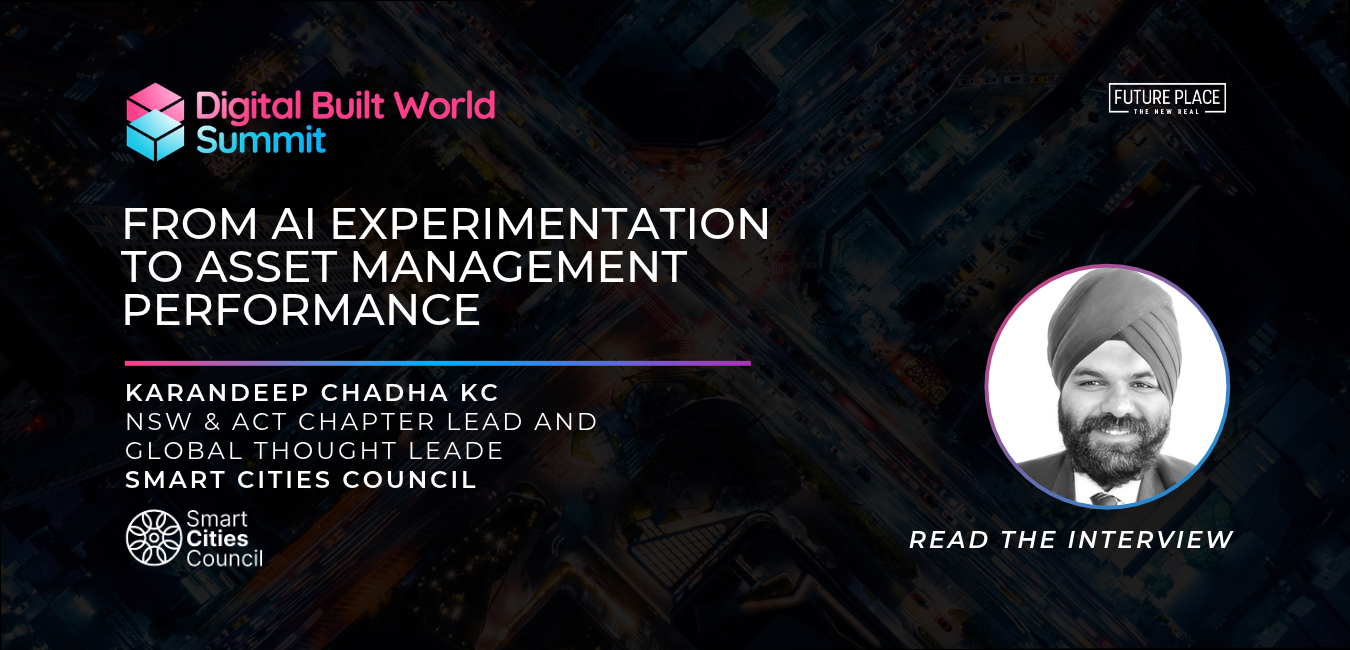
Karandeep Chadha KC is the NSW & ACT Chapter Lead and Global Thought Leader, Property & Infrastructure at Smart Cities Council, bringing around 20 years of experience across infrastructure, property, government, procurement, asset management, technology, data, risk and commercial strategy.
His recent experience includes senior roles with Transport for NSW, where he led asset and property management across a complex portfolio of 6,500 properties, and Property & Development NSW, where he worked on whole of government property strategy across a $160 billion portfolio. His broader career also brings experience from insurance and reinsurance, including catastrophe, climate risk and actuarial modelling, as well as supply chain management within major international FMCG organisations. This provides a broader perspective on how organisations can use data, modelling and technology to understand uncertainty, assess risk, optimise complex systems and make better decisions. Across these roles, the common thread has been using evidence, data and technology to improve strategic and operational decision making.
At Smart Cities Council, KC is focused on building capability and collaboration across the infrastructure ecosystem, while advancing digital transformation, AI readiness, governance and smart infrastructure practice. This includes working with members, industry partners and the broader ecosystem through advisory, education, events, taskforces, webinars, portfolio reviews and strategic industry relationships.
KC is a valued Program Advisor for Digital Built World summit (2-3 March, Sydney). We asked him a few questions about how AI is impacting the Asset Management function.
Q1. From experimentation to application
Smart Cities Council is seeing members experiment with applied AI for asset management. What are you seeing as the most promising applications, and what separates organisations that are successfully moving beyond AI pilots from those that remain in experimentation?
KC_ I think the most promising applications are the ones that solve a real business, operational or asset management problem rather than simply demonstrating what AI can do. Across my career I have worked at the intersection of property, infrastructure, technology, data, risk, procurement and commercial decision making, so I have seen how much value can be created when good information is connected to the right decision. My experience has ranged from actuarial and catastrophe risk modelling in insurance and reinsurance, through supply chain modelling and analytics in major international FMCG organisations, to more recent work across large property and infrastructure portfolios. In Transport for NSW and Property & Development NSW, this included computer vision, satellite and GIS analytics, drones, IoT, robotics, digital twins, spatial data, portfolio intelligence and AI driven applications. At Transport for NSW, for example, I secured funding for a geospatial and AI driven approach to illegal dumping detection, bringing together GIS data, records, drone imagery and predictive analytics.
Through Smart Cities Council, I now see these issues from a much broader industry perspective. We are engaging with organisations across infrastructure, property, engineering, technology and government, and there is a clear appetite to understand not just what AI can do, but how it can actually be applied. The organisations that move beyond pilots are generally the ones that start with the problem, understand the value they are trying to create and then build the data, governance and operating capability around it. That is also where I see an important role for Smart Cities Council. We can bring members together through events and taskforces, provide access to specialist advisory capability, develop education and face to face learning, share practical knowledge through online webinars and connect organisations with the wider ecosystem. The objective is to help organisations move from interesting experimentation towards practical implementation.
Q2. AI within asset management frameworks
Asset management is already governed by established frameworks, processes and standards. How should organisations think about integrating AI into these environments, particularly around data quality, governance, accountability and requirements such as ISO aligned asset management?
KC_I do not see AI as something that should sit outside an organisation’s asset management framework. It should become another capability within the existing decision making environment. The fundamentals of good asset management do not change. Organisations still need to understand what assets they have, the services those assets support, their condition, risks, costs, performance and expected lifecycle. AI can help organisations do many of those things faster and potentially with much greater insight, but it should strengthen the decision making process rather than replace accountability. My experience across asset management, strategy, procurement, technology and portfolio planning has reinforced the importance of connecting information, risk, cost and service outcomes rather than treating technology as a separate initiative. At Property and Development NSW, for example, I worked on lifecycle, performance and renewal frameworks and contributed to the NSW Asset Management Assurance Framework, alongside digital twins, data governance, digital asset registers and property intelligence initiatives.
The quality of the underlying information is therefore critical. If an organisation has incomplete asset registers, inconsistent data, unclear ownership or poor data lineage, AI can potentially make the problem more sophisticated without making the answer more reliable. This is why I think AI readiness is really an organisational capability issue, not simply a technology issue. Organisations need to consider data quality, security, accountability, transparency, human oversight and how AI generated insights are incorporated into established governance and assurance processes.
This is also an area where I see a strong opportunity for Smart Cities Council to support members. We are developing a broader range of practical services that can help organisations assess where they are today and identify what needs to happen next. This can include an independent review of an organisation’s strategy, policies and plans, followed by a practical action plan. It can also include advisory support, education, member webinars and access to specialist expertise. Rather than telling organisations that they need to adopt the latest technology, the focus is on understanding their existing position, identifying the gaps and helping them develop a sensible pathway forward.
Q3. What does the next generation of asset management look like?
Drawing on your experience across asset management and your current perspective across the Smart Cities Council ecosystem, how do you see AI changing the way infrastructure owners understand asset condition, assess risk and make lifecycle investment decisions over the next few years?
KC_I think we are moving from an asset management model that is often based on periodic inspections, historical information and fragmented systems towards one that is increasingly continuous, connected and intelligence led. My perspective on this comes from quite a broad range of experience. I have worked with physical property and infrastructure assets, but I have also spent time working with catastrophe and climate risk, actuarial modelling in insurance and reinsurance, supply chain modelling and analytics in major international FMCG organisations, as well as technology, data and commercial decision making. Those experiences all have a common theme. They involve trying to understand complex systems, identify risk and uncertainty, model different scenarios and make better decisions with imperfect information.
That is why I see AI as potentially much more significant than simply automating inspections or identifying defects. The opportunity is to connect condition information, spatial data, imagery, sensor information, maintenance history, financial information, environmental factors and operational data to create a much more complete picture of an asset and its context. AI can then help identify patterns, emerging risks and potential interventions that may not be obvious when those sources of information are considered separately.
The bigger change will be in how investment decisions are made. Rather than asking only which assets need attention today, infrastructure owners will increasingly be able to ask where intervention will create the greatest long term value, reduce risk, improve service outcomes or extend asset life. That is where I see the Smart Cities Council role becoming particularly important. We are building a platform where members can access not only thought leadership, but practical support through advisory services, education, events, taskforces, online webinars, portfolio reviews and connections across the market.
One of the areas I am particularly interested in is the opportunity to provide independent reviews of members’ strategies, policies and plans. An organisation may have a good strategy or asset management framework, but still need an external perspective on how well it is positioned for the next stage of digital and AI enabled infrastructure. A structured review can identify gaps, priorities and opportunities and turn those findings into a practical action plan.
The broader objective is to create a genuine ecosystem rather than simply a membership organisation. That means bringing practitioners together around important challenges through taskforces, creating opportunities for face to face education and events, sharing practical knowledge through our online webinar series, connecting organisations with relevant expertise through the Marketplace and developing strategic relationships with major industry organisations. It also means understanding the individual needs of members through account management and helping connect them to the right services and people across the ecosystem.
Ultimately, I think the next generation of asset management will be much more connected, predictive and intelligence led, but it will still depend on good judgement. AI can give asset owners better information and better insight, but people still need to decide what matters, what should be prioritised and what represents value. The opportunity for Smart Cities Council is to help organisations build the capability to make those decisions with better information, better technology and stronger collaboration across the ecosystem.
If you would like to meet KC and others with a passion for applied AI in asset management, then check out the Digital Built World summit on 2-3 March in Sydney.










 Hexagon is the global leader in digital reality solutions, combining sensor, software and autonomous technologies. Our solutions free our customers to harness the rapidly-increasing amounts of data, putting it to work to boost efficiency, productivity, quality and safety across industrial, manufacturing, infrastructure, public sector and mobility applications.
 Willow is the “digital twin” for the built world. Through its software, Willow creates a digital replica of a built asset, that collects and aggregates data into a “twin”. Through this approach, Willow


 Established in 1998, Glodon Company Limited was listed on the A-share market in May 2010 (abbreviated as Glodon, Stock Code: 002410) in China, being the first listed company in the field of construction engineering information in China. Glodon provides more than 100 “Terminal + Cloud + Big Data” based products/services, industry big data, industry new finance, and other value-added services as the provider of a digital building platform, which centres on the entire life cycle of construction projects with the professional applications of construction engineering as the core support. With more than 8,000 employees, currently, Glodon has established more than 80 branches around the world, providing services to customers in over 100 countries and regions. Its sales and service network covers more than 200 cities worldwide, providing professional applications and services to over 310,000 professional clients globally.