
- November 23, 2026
- Business
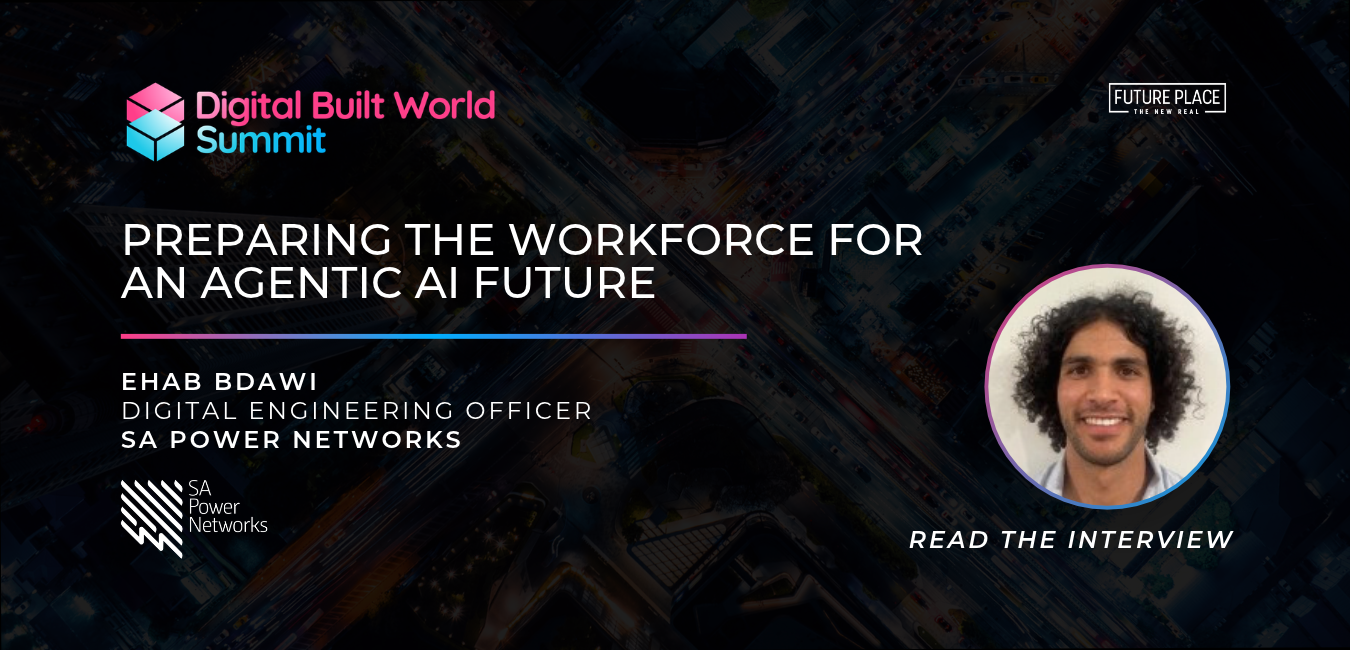
Ehab Bdawi is a Digital Engineering Officer at SA Power Networks, working at the intersection of digital engineering, data and the technologies supporting the management of critical infrastructure. His perspective spans the practical application of digital engineering within an asset-intensive organisation and the organisational changes required to adopt new technologies effectively.
As AI moves from assisting individual tasks towards autonomous and agentic workflows, Ehab is particularly interested in three interconnected areas: people (leadership and change management), data foundations and technology. In each, the question is how organisations upskill their existing workforce, redefine roles and establish the capabilities needed to work productively with AI agents. I asked him to elaborate on these issues.
Q1. As AI agents move from answering questions to performing increasingly complex engineering and asset-management tasks, how should organisations approach upskilling their existing teams rather than simply hiring new AI specialists?
Ehab Bdawi_ Existing people are one of the greatest asset to organisations. They understand how the organisation is structured, they bring deep experience in their fields, and they know how things actually work in practice. That’s the context an AI agent can’t learn on its own, and it’s what makes the human contribution irreplaceable. AI can support each of those areas and add a significant lift to individual productivity, but it works best alongside that knowledge rather than in place of it.
How we use these tools is just as important as the tools themselves. If people don’t understand what happens behind the scenes, such as where their data goes, how it’s processed and what the agent can access, there’s a real risk of exposing sensitive information without realising it. So upskilling can’t stop at “how to use the tool”. It also has to cover responsible use, data security and an understanding of the limits of what the AI is doing. Investing in that education for our existing teams is how we get the benefits while managing the risks.
Q2. Asset management decisions depend on reliable information about what assets we have, their condition and how they perform over time. How does digital engineering, through structured data, standards and governance, create the foundation that lets AI agents support asset management decisions with confidence?
Ehab Bdawi_ Digital engineering techniques are shaping the asset lifecycle from planning all the way through to disposal. During design and delivery, they improve coordination, speed up project delivery and reduce variation. They also lift data quality, which flows through to better construction outcomes.
Just as important is the information we carry forward. Knowing what was designed, what was actually built, and what gets handed over at each stage gives the teams who manage and operate the asset what they need to do it well. That same information supports better end-of-life decisions and reduces environmental impact at disposal.
This is the foundation AI agents will depend on. If the data is structured, governed and handed over consistently at every stage, agents can support asset management decisions with confidence. Without it, they’d only be automating uncertainty.
Q3. Beyond technical capability, what change-management challenges are likely to determine whether Agentic AI succeeds — and how do you bring engineers and operational teams with you when AI begins changing the way they work?
Ehab Bdawi_ The biggest change-management challenges aren’t technical. They are fear, trust and clarity about what AI means for people’s roles. Anything new brings a fear of the unknown, and that’s a reasonable response. The way AI is often talked about, as something that will take over jobs and replace people, is unsettling, and so is the speed at which it’s developing. Those concerns deserve to be taken seriously rather than brushed aside.
Bringing people with us starts with being open and vulnerable about those concerns. That means acknowledging the uncertainty honestly, putting guardrails in place to protect people from the risks they’re worried about, and building trust, and genuinely meaning it. Alongside that, we need to show people the value they can gain from the technology. AI will remove many of the boring, repetitive tasks, but it won’t replace the human side of work. People will always want human interaction and someone they can build trust with, and that’s very hard to do with a machine.
This feels like another era of change, much like the industrial revolution. We’re moving forward quickly and we need to keep pace, but we can do it in a way that brings people along rather than leaving them behind. Government also has a significant role to play. Clear policy and sensible guardrails are needed so that AI benefits people rather than damaging their careers, their passions and the work they care about.
If Agentic AI is your focus, then check out the Digital Built World Summit in Sydney on 2-3 March. You will meet a unique group of people including Ehab, who are helping to integrate AI and automation into infrastructure asset management.












 Hexagon is the global leader in digital reality solutions, combining sensor, software and autonomous technologies. Our solutions free our customers to harness the rapidly-increasing amounts of data, putting it to work to boost efficiency, productivity, quality and safety across industrial, manufacturing, infrastructure, public sector and mobility applications.
 Willow is the “digital twin” for the built world. Through its software, Willow creates a digital replica of a built asset, that collects and aggregates data into a “twin”. Through this approach, Willow


 Established in 1998, Glodon Company Limited was listed on the A-share market in May 2010 (abbreviated as Glodon, Stock Code: 002410) in China, being the first listed company in the field of construction engineering information in China. Glodon provides more than 100 “Terminal + Cloud + Big Data” based products/services, industry big data, industry new finance, and other value-added services as the provider of a digital building platform, which centres on the entire life cycle of construction projects with the professional applications of construction engineering as the core support. With more than 8,000 employees, currently, Glodon has established more than 80 branches around the world, providing services to customers in over 100 countries and regions. Its sales and service network covers more than 200 cities worldwide, providing professional applications and services to over 310,000 professional clients globally.