
- November 23, 2026
- Business
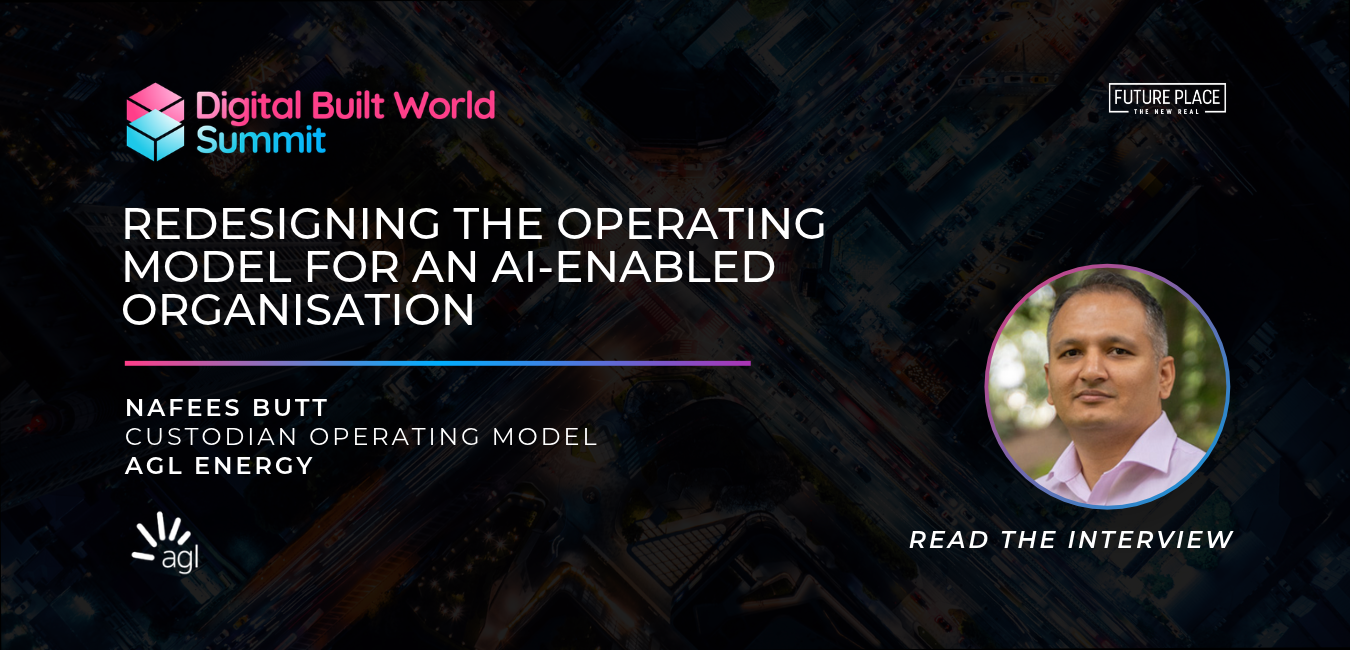
Nafees Butt is Custodian of the Operating Model at AGL, specialising in operational excellence, operating-model design and business transformation. He has extensive experience in organisational design, Agile, Lean and new ways of working. His current work explores how operating models and structured organisational knowledge can support enterprise AI. Its a specialist area that most of us don’t think about but in the Age of AI, we need to reassess every part of our business.
Nafees is particularly interested in the connection between data, processes, people and technology. He argues that strong data connectivity is critical to realising the full value of AI, rather than simply deploying isolated AI tools. His work focuses on creating the structures and capabilities organisations need to adapt and scale. We asked him three questions to draw out his lessons.
Q1. As AI and agentic workflows become more capable, which parts of the operating model need to change first — roles, processes, decision rights or organisational structure?
Nafees Butt_ It is quite common for organisations to jump straight into redesigning roles or shuffling the orgchart, but that’s putting the cart before the horse. While structure, roles, processes, and decision rights all matter, the most foundational shift we need to make is introducing semantic lineage into the operating model. If you don’t map out your semantic lineage, you’re just automating chaos. At its core, that lineage rests on three key nodes:
1. Strategy (where the business wants to go),
2. Work (what is actually being executed), and
3. Outcomes (the actual impact on the customer, market, or business).
To connect these nodes, you have to build three distinct edges:
Edge 1: Translating strategy down into work to ensure alignment.
Edge 2: Connecting the work to measure what real outcomes it has achieved
Edge 3: Feeding those measured outcomes back up to reshape strategy
Until you build this semantic framework into the core of your operating model, tweaking your structure or decision rights won’t get you far with autonomous agents.
Q3. You’ve highlighted data connectivity as critical to realising AI’s full value. What does an organisation need to connect — and what happens when its data, systems and processes remain fragmented?
Nafees Butt_ I have briefly touched on the three nodes that an organisation needs to connect using the three edges. While most organisations have actually gotten pretty decent at Edge 1(i.e. taking high-level strategy and cascading it down into project work or backlogs, often backed by modern tooling), but where the Operating Models break down today is Edge 2 and Edge 3. This is where the real frontier is.
Edge 2 is about hardwiring your telemetry and processes so you are actually tracking true outcomes (not just “did we deliver the work on time?”, but what actual impact it had on the customer, market, or business). Edge 3 is using that measured outcome data to close the loop, traversing back up to inform your next strategic choices. When your data, systems, and processes remain fragmented, you miss Edges 2 and 3 entirely.
Without Edge 2, an organisation has no systematic way to evaluate whether delivered work actually achieved its intended purpose or moved the needle for the customer. Without Edge 3, that blind spot is locked in, meaning leadership keeps making future strategic choices in a vacuum without learning from past execution. When you drop AI and agentic workflows into that environment, they inherit that exact same disconnection, i.e. they can execute tasks, but because they have no telemetry connecting work to real-world outcomes or strategic feedback, they operate without context, leading to wasted capital and misdirected capabilities.
Q3. How can asset-intensive organisations redesign their operating model so AI becomes part of how work is actually done, rather than another layer of technology sitting alongside the business?
Nafees Butt_ To stop AI from becoming just another expensive piece of software sitting on the sidelines, asset-intensive organisations have to embed it directly into the execution fabric of their operating model by anchoring it to those same three edges of semantic lineage.
When you’re dealing with heavy infrastructure—whether it’s managing a transport network, an energy grid, or physical assets—organisations historically drown in telemetry (like road sensors, traffic metrics, and maintenance logs) but keep that data trapped in silos. If AI is just plugged in as a separate dashboard, field crews and operators will ignore it because it doesn’t connect to their actual workflows.
Instead, AI needs to live inside the semantic pathways of the asset lifecycle. That means using a clean canonical taxonomy to ensure Edge 1 connects capital strategy to field execution, Edge 2 streams real-time asset health and operational outcomes back into the system, and Edge 3 closes the loop to inform future planning. When your physical operations and strategic objectives share that connected lineage, AI stops feeling like an external IT project. It becomes the underlying intelligence that helps your teams predict asset health, dynamically shift accountabilities when agentic workflows kick in, and ensure that every automated action ties directly back to real-world outcomes.
If you are interested in AI for asset management and its impact across operations, check out the Digital Built World summit in Sydney on 2-3 March. Its now in its 6th edition and focuses on helping you achieve intelligent infrastructure through perfecting the digital asset lifecycle.









 Hexagon is the global leader in digital reality solutions, combining sensor, software and autonomous technologies. Our solutions free our customers to harness the rapidly-increasing amounts of data, putting it to work to boost efficiency, productivity, quality and safety across industrial, manufacturing, infrastructure, public sector and mobility applications.
 Willow is the “digital twin” for the built world. Through its software, Willow creates a digital replica of a built asset, that collects and aggregates data into a “twin”. Through this approach, Willow


 Established in 1998, Glodon Company Limited was listed on the A-share market in May 2010 (abbreviated as Glodon, Stock Code: 002410) in China, being the first listed company in the field of construction engineering information in China. Glodon provides more than 100 “Terminal + Cloud + Big Data” based products/services, industry big data, industry new finance, and other value-added services as the provider of a digital building platform, which centres on the entire life cycle of construction projects with the professional applications of construction engineering as the core support. With more than 8,000 employees, currently, Glodon has established more than 80 branches around the world, providing services to customers in over 100 countries and regions. Its sales and service network covers more than 200 cities worldwide, providing professional applications and services to over 310,000 professional clients globally.